
SCA Autumn Quiz Night
Thank you to everyone who
attended our Autumn Quiz Night. It
was a great success and a
thoroughly enjoyable evening with
quiz master Peter Hinde and the
SCA team.
Ceddesfeld Hall Upcoming Events
Sedgefield Sounds featuring
Mamma Said, Saturday 24 October,
7pm for 7.30pm
An evening of live acoustic music
featuring local performers. Tickets
£5, available from the bar (cash
only), Maggie (07970 761844) or
Sarah (07847 052761).
Christmas Craft Fayre, Saturday 28
November, 1pm to 4pm
Part of the STC Snow Party and
Parade. Community bar open until
7pm.
Mulled Wine & Mince Pies, Friday
18 December, 7pm
Following Carols on the Green.
Proceeds to Butterwick Hospice.
Christmas Kanikapila, Friday 18
December, 7.15pm
Featuring the Sedgefield Smile Time
Ukulele Band. Free entry.
SCA Christmas Eve Quiz, Thursday
24 December, 8pm
Free event, including a raffle.
Membership 2026/27
Annual membership fees are:
Adults (under 60): £10
Seniors: £9
Under 18s/full-time students: £5
Payments can be made at the bar or
by bank transfer via
membership@sedgefieldsca.org.uk.
Membership is vital to the continued
running of SCA and Ceddesfeld Hall.
New members are always welcome
.jpg)
I have been going out with the Cleveland Naturalists recently as part of their
summer programme, and the September trip was to a place I had only visited
once before: Castle Eden Dene.
If you haven't visited, it is well worth a trip.
It gave me the impression of stepping back in time, with its massive trees,
abundant ferns, horsetails and ancient rock formations. Located on the edge
of Peterlee, Castle Eden Dene is the largest area of natural woodland in North
East England and is renowned for its yew trees.
This tangled landscape is a
survivor of the 'wildwood' that once covered much of Britain. It is a Site of
Special Scientific Interest, managed by Natural England, and is home to an
extraordinary variety of birds, more than 450 species of plants, and some of
our favourite mammals, including roe deer and foxes.
At 3.5 miles (5.6 km) long, it covers 221 hectares of woodland and lowland
grassland, with several access points, and is signposted from the A19 and
Peterlee.
During our walk, the birds were a little quiet, but we did see several buzzards
and a sparrowhawk flying past, along with a great spotted woodpecker and a
marsh tit. We also saw an array of fungi, including the bracket fungus Dryad's
Saddle (Cerioporus squamosus) and Dead Moll's Fingers (Xylaria longipes), a
very strange dark, finger-like fungus that grows on fallen or decaying
hardwood branches, especially beech and sycamore.
We had a geologist with us who explained that the steep gorge of the Dene
was carved by post-glacial meltwaters dissolving the soft Magnesian
Limestone, creating some spectacular cliffs and geological features. When
we reached the bottom of the Dene, we expected to see water flowing, but the
stream has created an underground channel, so it often disappears and
reappears further down the Dene.
The Dene is rich in history. The Saxons called this area Yoden, meaning 'Yew
Dene', from which we get the name Eden today. The Burdon family, owners of
the land from 1757 until the mid-20th century, built a large stately home on
the edge of the Dene known as The Castle. They created many of the paths
that still cross the reserve today.
Some of the larger geological features have been given names and stories,
including the 'Kissing Frogs' and the huge 'Devil's Lapstone'. Legend tells how
the Devil offered to help build Durham Cathedral. He planned to make
foundations of rock so crumbly that, when thousands of people crowded into
the cathedral for its opening, the building would collapse, killing everyone
inside.
So, whether you are interested in natural history, history, geology or mythology,
Castle Eden Dene is well worth a visit.
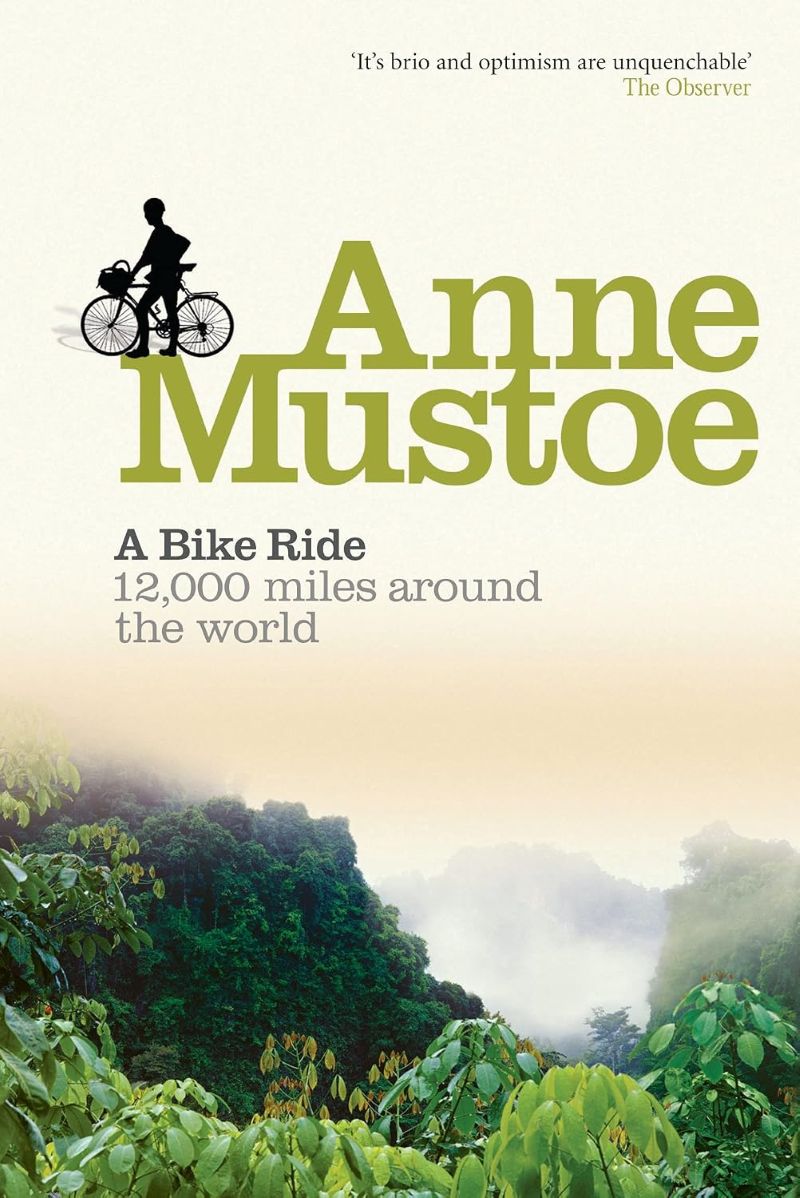 The Book Group
read A Bike Ride by
Anne Mustoe.
The Book Group
read A Bike Ride by
Anne Mustoe.